
Introduction
Biostatistics has always played a central role in biological, medical, and public health research. From clinical trials and epidemiological studies to ecological modeling and genomics, biostatistics provides the mathematical foundation for transforming raw biological data into meaningful scientific conclusions.
In recent years, Artificial Intelligence (AI) has emerged as a powerful force reshaping the way biostatistical analyses are performed. The integration of AI into biostatistics is not merely an upgrade of existing statistical tools—it represents a paradigm shift in how complex, high-dimensional biological data are analyzed, interpreted, and applied in real-world decision-making.
With the explosion of big data in genomics, proteomics, medical imaging, electronic health records (EHRs), and environmental monitoring, traditional statistical methods often struggle to handle data volume, velocity, and complexity. AI techniques—especially machine learning (ML), deep learning (DL), and natural language processing (NLP)—offer scalable and adaptive solutions to these challenges.
This article explores the role of Artificial Intelligence in Biostatistics, its applications, advantages, limitations, ethical considerations, and future directions. The discussion is tailored for students, researchers, clinicians, and data scientists working in biological and health sciences.
Understanding Artificial Intelligence in Biostatistics
Artificial Intelligence refers to computer systems capable of performing tasks that typically require human intelligence, such as learning from data, recognizing patterns, making predictions, and adapting to new information.
In biostatistics, AI complements classical statistical approaches by:
- Learning complex non-linear relationships
- Handling large and unstructured datasets
- Automating model selection and feature extraction
- Improving prediction accuracy
Key AI Techniques Used in Biostatistics
| AI Technique | Description | Common Biostatistical Use |
|---|---|---|
| Machine Learning | Algorithms that learn patterns from data | Disease prediction, risk modeling |
| Deep Learning | Neural networks with multiple layers | Medical imaging, genomics |
| Natural Language Processing (NLP) | Analysis of text data | Clinical notes, literature mining |
| Reinforcement Learning | Learning through reward-based feedback | Treatment optimization |
| Computer Vision | Image recognition and analysis | Histopathology, radiology |
Why AI Is Needed in Modern Biostatistics
Traditional biostatistical methods—such as t-tests, ANOVA, regression, and survival analysis—remain essential. However, modern biological datasets present new challenges:
- High dimensionality (e.g., thousands of genes vs. few samples)
- Non-linear relationships
- Missing and noisy data
- Real-time data streams
- Unstructured data (images, text, signals)
AI algorithms are designed to learn directly from data without requiring strict assumptions (normality, linearity, independence), making them particularly powerful in complex biological systems.
Major Applications of AI in Biostatistics
1. AI in Clinical Trials
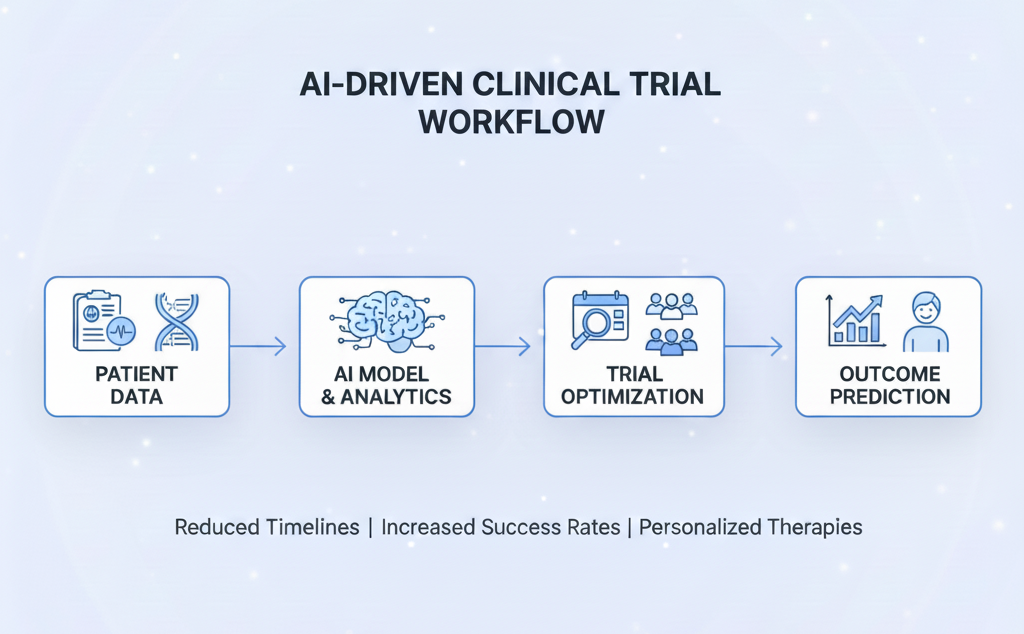
AI improves clinical trial design and analysis by:
- Predicting patient recruitment rates
- Identifying optimal inclusion/exclusion criteria
- Detecting adverse events early
- Improving adaptive trial designs
2. AI in Disease Prediction and Diagnosis
Machine learning models are widely used for:
- Cancer detection
- Cardiovascular risk prediction
- Diabetes classification
- Infectious disease surveillance
Algorithms such as Random Forest, Support Vector Machines (SVM), and Neural Networks outperform traditional logistic regression in many high-dimensional settings.
3. AI in Genomics and Bioinformatics
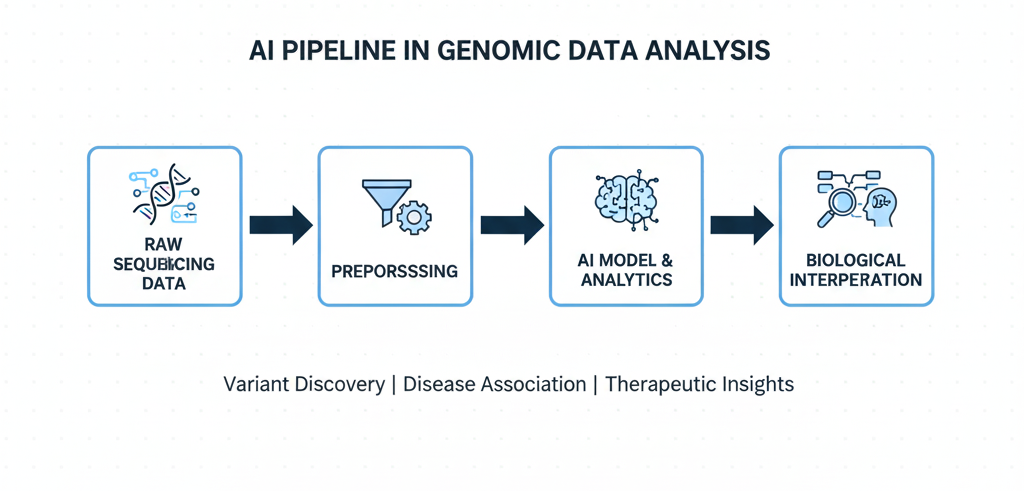
Genomic datasets are massive and complex, making AI indispensable for:
- Gene expression analysis
- Variant detection
- Functional annotation
- Biomarker discovery
Deep learning models can identify patterns in DNA sequences that are difficult for traditional models to capture.
4. AI in Epidemiology and Public Health
AI enhances population-level studies by:
- Forecasting disease outbreaks
- Modeling disease transmission
- Analyzing spatial and temporal data
- Supporting public health decision-making
During pandemics, AI models assist in real-time surveillance and intervention planning.
5. AI in Medical Imaging and Diagnostics
Biostatistics combined with AI enables automated analysis of:
- X-rays
- CT scans
- MRI images
- Histopathological slides
Convolutional Neural Networks (CNNs) are particularly effective in image-based diagnostics.
Comparison: Traditional Biostatistics vs AI-Based Biostatistics
| Feature | Traditional Biostatistics | AI-Based Biostatistics |
|---|---|---|
| Assumptions | Strong (normality, linearity) | Minimal or none |
| Data Size | Small to moderate | Large and complex |
| Interpretability | High | Often low (black box) |
| Prediction Accuracy | Moderate | High |
| Automation | Limited | High |
| Adaptability | Low | High |
Advantages of Integrating AI into Biostatistics
- Improved predictive accuracy
- Ability to analyze big and complex data
- Automation of repetitive analytical tasks
- Detection of hidden patterns
- Real-time decision support
- Scalability across domains
These benefits make AI an essential tool in modern biomedical research.
Limitations and Challenges
Despite its advantages, AI in biostatistics faces several challenges:
1. Interpretability Issues
Many AI models act as “black boxes,” making it difficult to explain results to clinicians and policymakers.
2. Data Quality Dependence
AI models are only as good as the data used for training.
3. Overfitting Risks
Complex models may fit noise instead of true biological signals.
4. Ethical and Bias Concerns
Bias in training data can lead to unfair or inaccurate predictions.
5. Need for Statistical Expertise
AI does not replace biostatistical thinking; it enhances it.
Ethical Considerations in AI-Driven Biostatistics
Ethics plays a crucial role when applying AI to biological and health data:
- Data privacy and confidentiality
- Informed consent
- Algorithmic transparency
- Bias mitigation
- Responsible reporting
Biostatisticians must ensure AI models are scientifically valid, ethically sound, and socially responsible.
Popular AI Tools and Software Used in Biostatistics
| Tool/Platform | Application |
|---|---|
| R (caret, tidymodels) | Statistical ML modeling |
| Python (scikit-learn, TensorFlow) | Machine & deep learning |
| SPSS Modeler | Predictive analytics |
| SAS | AI-assisted analytics |
| MedCalc | Clinical statistics |
| Custom Tools (e.g., BioStatX) | GUI-based AI biostatistics |
Future of Artificial Intelligence in Biostatistics
The future integration of AI into biostatistics is promising and transformative:
- Explainable AI (XAI) will improve model transparency
- Hybrid models will combine classical statistics with AI
- AI-driven decision systems will assist clinicians
- Personalized medicine will become more precise
- Open-source AI biostatistical tools will grow
AI will not replace biostatisticians—it will empower them to solve more complex biological problems with greater accuracy and efficiency.
Conclusion
The integration of Artificial Intelligence into Biostatistics marks a new era in biological and medical research. By complementing traditional statistical methods, AI enables researchers to analyze complex datasets, uncover hidden patterns, and make data-driven decisions with unprecedented precision.
However, successful implementation requires a strong foundation in biostatistics, careful attention to ethical considerations, and a clear understanding of model limitations. When used responsibly, AI has the potential to revolutionize clinical research, public health, genomics, and personalized medicine.
For students, researchers, and professionals in the life sciences, learning AI-based biostatistical methods is no longer optional—it is essential for staying relevant in the rapidly evolving world of data-driven research.