
Introduction
Early detection of disease outbreaks is one of the most critical challenges in public health and epidemiology. Traditional surveillance systems rely heavily on manual reporting, laboratory confirmations, and delayed data aggregation, which often results in late responses to emerging health threats. In a globally connected world, where infectious diseases can spread rapidly across borders, delayed detection can lead to severe health, economic, and social consequences.
Artificial Intelligence (AI)-based outbreak detection has emerged as a powerful solution to overcome the limitations of conventional surveillance methods. By integrating machine learning, big data analytics, and real-time information streams, AI enables faster, more accurate, and proactive identification of disease outbreaks.
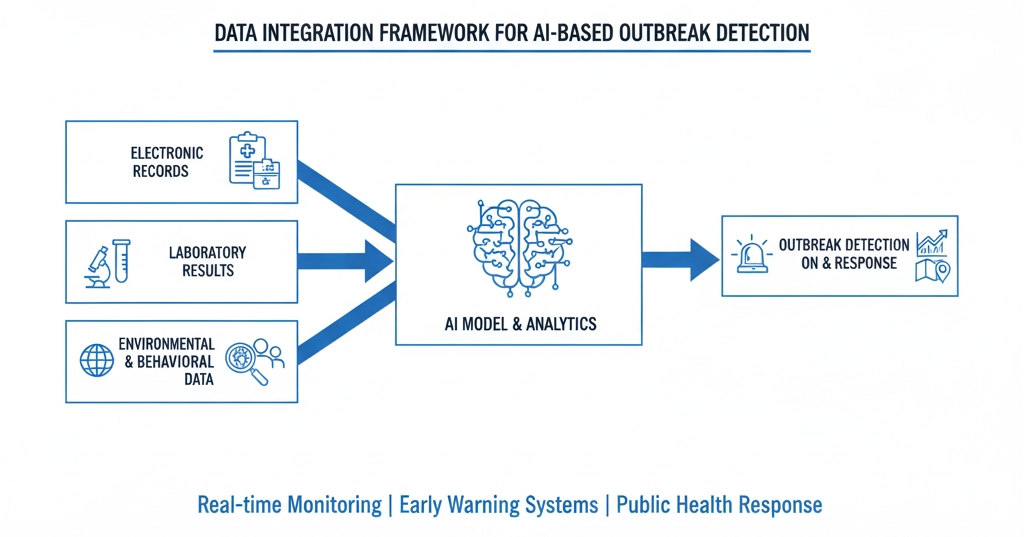
AI-based outbreak detection systems analyze vast amounts of structured and unstructured data—such as hospital records, laboratory results, climate data, social media activity, and mobility patterns—to identify abnormal trends and predict potential outbreaks before they escalate.
This article explores the concept, methods, applications, advantages, challenges, and future prospects of AI-based outbreak detection, with a focus on its role in biostatistics, epidemiology, and public health decision-making.
What Is AI-Based Outbreak Detection?
AI-based outbreak detection refers to the use of artificial intelligence and machine learning algorithms to identify, monitor, and predict infectious disease outbreaks in real time or near real time.
Unlike traditional surveillance systems that depend on predefined thresholds and delayed reports, AI-driven systems continuously learn from data patterns and detect subtle deviations that may indicate an emerging outbreak.
Core Components of AI-Based Outbreak Detection
| Component | Description |
|---|---|
| Data Collection | Real-time health, environmental, and social data |
| Data Processing | Cleaning, integration, and normalization |
| AI Algorithms | Machine learning and deep learning models |
| Pattern Detection | Identification of abnormal trends |
| Prediction | Forecasting outbreak spread and intensity |
| Decision Support | Alerts and recommendations for intervention |
Why AI Is Needed for Outbreak Detection
Traditional outbreak detection methods face several limitations:
- Delayed reporting and underreporting
- Dependence on laboratory confirmation
- Limited ability to handle big and complex data
- Static thresholds that miss early signals
- Inability to integrate non-health data sources
AI addresses these challenges by offering adaptive, scalable, and data-driven surveillance systems capable of detecting outbreaks earlier and more accurately.
Data Sources Used in AI-Based Outbreak Detection
AI systems rely on multiple data streams to enhance detection accuracy.
Major Data Sources
| Data Type | Examples |
|---|---|
| Clinical Data | Hospital admissions, symptoms, diagnoses |
| Laboratory Data | Test results, pathogen sequencing |
| Epidemiological Data | Case counts, mortality rates |
| Environmental Data | Temperature, rainfall, air quality |
| Mobility Data | Travel patterns, population movement |
| Digital Data | Social media, search queries, news reports |
AI and Machine Learning Techniques Used
Several AI techniques are commonly applied in outbreak detection:
1. Supervised Machine Learning
Used when labeled outbreak data are available.
- Logistic regression
- Random forest
- Support vector machines
2. Unsupervised Learning
Detects anomalies without predefined labels.
- Clustering
- Principal Component Analysis (PCA)
- Autoencoders
3. Deep Learning
Handles high-dimensional and unstructured data.
- Recurrent Neural Networks (RNN)
- Long Short-Term Memory (LSTM)
- Convolutional Neural Networks (CNN)
4. Natural Language Processing (NLP)
Extracts outbreak-related information from text.
- News reports
- Social media posts
- Clinical notes
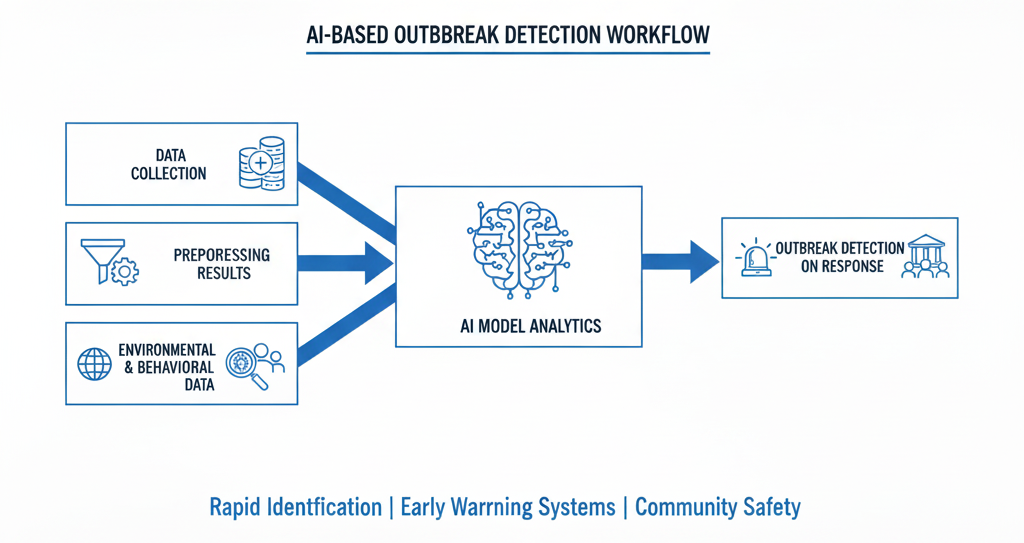
AI-Based Outbreak Detection Workflow
Key Steps
- Data acquisition from multiple sources
- Data cleaning and preprocessing
- Feature extraction and selection
- Model training and validation
- Real-time monitoring and alert generation
- Decision support for public health authorities
Applications of AI-Based Outbreak Detection
1. Early Detection of Infectious Diseases
AI systems can detect early signs of:
- Influenza outbreaks
- COVID-19 resurgence
- Dengue and malaria spread
- Zoonotic disease emergence
Early detection allows health authorities to implement control measures before widespread transmission occurs.
2. Pandemic Surveillance
During pandemics, AI-based surveillance helps in:
- Tracking real-time case trends
- Predicting peak infection periods
- Identifying high-risk regions
- Optimizing resource allocation
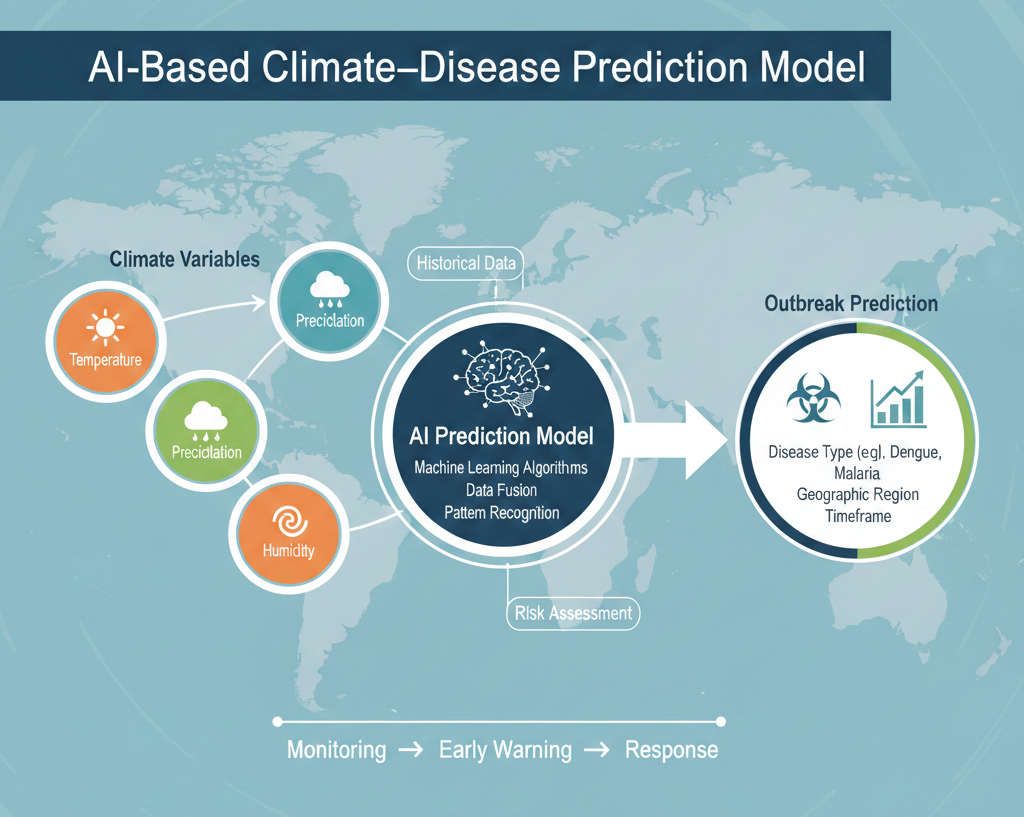
3. Climate-Driven Disease Monitoring
AI models integrate climate data to predict outbreaks of climate-sensitive diseases such as:
- Dengue
- Cholera
- Malaria
4. Global Disease Surveillance
AI-powered platforms enable cross-border outbreak monitoring by analyzing global data sources, helping international organizations respond faster to emerging threats.
Comparison: Traditional vs AI-Based Outbreak Detection
| Feature | Traditional Methods | AI-Based Methods |
|---|---|---|
| Detection Speed | Slow | Fast |
| Data Volume | Limited | Massive |
| Data Types | Structured | Structured + Unstructured |
| Adaptability | Low | High |
| Prediction Ability | Limited | Advanced |
| Automation | Low | High |
Advantages of AI-Based Outbreak Detection
- Early warning capability
- Real-time surveillance
- Improved prediction accuracy
- Integration of diverse data sources
- Scalability across regions
- Support for evidence-based decision-making
These advantages make AI a vital tool for modern epidemiology and public health systems.
Challenges and Limitations
Despite its potential, AI-based outbreak detection faces several challenges:
1. Data Quality Issues
Incomplete, biased, or noisy data can reduce model reliability.
2. Interpretability
Many AI models function as “black boxes,” making it difficult to explain predictions.
3. Privacy and Ethical Concerns
Use of personal and digital data raises concerns about confidentiality and consent.
4. Infrastructure Requirements
AI systems require advanced computational resources and skilled personnel.
5. False Positives
Over-sensitive models may generate unnecessary alerts.
Ethical and Legal Considerations
Ethical implementation of AI-based outbreak detection requires:
- Data anonymization
- Transparent algorithms
- Bias reduction
- Clear governance frameworks
- Responsible communication of risk
Public trust is essential for the success of AI-driven surveillance systems.
AI Tools and Platforms for Outbreak Detection
| Tool/Platform | Application |
|---|---|
| Python (scikit-learn, TensorFlow) | Predictive modeling |
| R (surveillance, caret) | Epidemiological analysis |
| GIS Tools | Spatial outbreak mapping |
| NLP Systems | Media-based detection |
| Custom AI Dashboards | Real-time monitoring |
Future of AI-Based Outbreak Detection
The future of outbreak detection will increasingly rely on AI-driven systems:
- Explainable AI for transparent predictions
- Integration with wearable health data
- Real-time global surveillance networks
- Hybrid models combining AI and biostatistics
- Automated policy recommendation systems
AI will play a key role in strengthening global preparedness against future pandemics.
Conclusion
AI-based outbreak detection represents a major advancement in public health surveillance and epidemiology. By leveraging artificial intelligence, machine learning, and real-time data integration, these systems enable earlier detection, better prediction, and more effective response to infectious disease outbreaks.
While challenges related to data quality, ethics, and interpretability remain, the benefits of AI-driven surveillance far outweigh the limitations when implemented responsibly. For public health professionals, biostatisticians, and researchers, AI-based outbreak detection is no longer a future concept—it is a critical tool for protecting global health in an increasingly interconnected world.