
Introduction
In modern healthcare research, enormous volumes of data are generated daily in the form of clinical notes, research articles, electronic health records, discharge summaries, and social media health discussions. Unlike structured datasets (numbers in rows and columns), this information exists as unstructured text. Extracting meaningful insights from such data is challenging using traditional statistical methods.
This is where Natural Language Processing (NLP) plays a transformative role.
Natural Language Processing is a branch of artificial intelligence that enables computers to understand, interpret, and analyze human language. When combined with biostatistics, NLP allows researchers to convert textual medical information into structured, analyzable data.
In this article, we explore how NLP integrates with biostatistics, its applications, tools, workflow, challenges, and future scope in biomedical research.
What is Natural Language Processing (NLP)?
Natural Language Processing (NLP) is a subfield of Artificial Intelligence (AI) that focuses on enabling machines to understand and process human language.
Key components of NLP include:
- Text preprocessing
- Tokenization
- Stemming and Lemmatization
- Named Entity Recognition (NER)
- Sentiment Analysis
- Topic Modeling
- Language Modeling
In biostatistics, NLP converts clinical text into quantifiable variables suitable for statistical analysis.
Why NLP is Important in Biostatistics
Biostatistics traditionally focuses on analyzing structured numerical datasets. However, healthcare data is largely unstructured.
Examples of unstructured biomedical data:
- Doctor’s clinical notes
- Radiology reports
- Pathology findings
- Patient discharge summaries
- Research publications
- Public health surveillance reports
More than 70% of healthcare data is textual. NLP bridges this gap by converting unstructured text into structured variables for statistical modeling.
Applications of NLP in Biostatistics
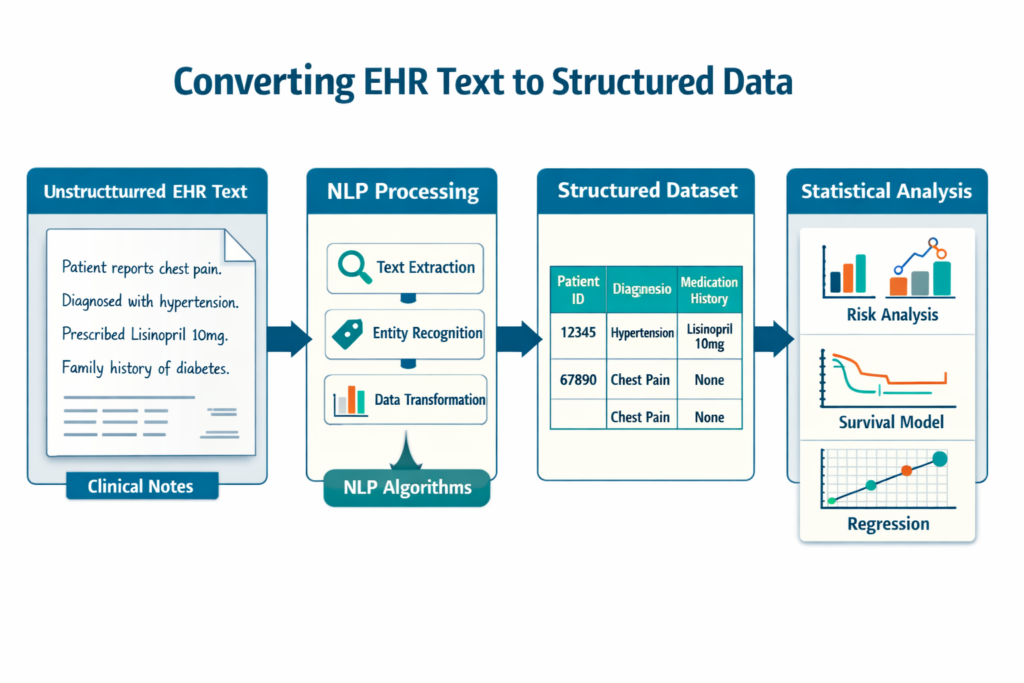
1. Electronic Health Records (EHR) Analysis
NLP extracts key information such as:
- Disease diagnosis
- Medication history
- Symptoms
- Risk factors
These extracted variables can then be analyzed using regression, survival analysis, or ANOVA.
2. Clinical Trial Data Mining
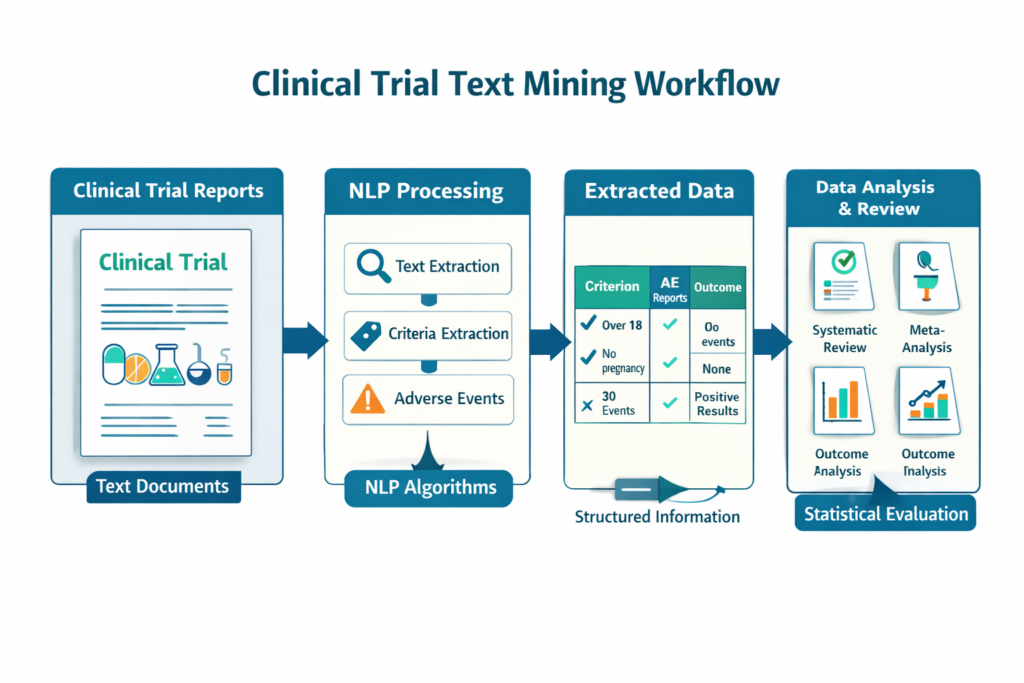
Clinical trial reports contain valuable textual information. NLP helps in:
- Identifying adverse drug reactions
- Extracting inclusion/exclusion criteria
- Analyzing patient outcomes
This improves meta-analysis and systematic reviews.
3. Pharmacovigilance
Pharmacovigilance monitors drug safety. NLP can analyze:
- Patient complaints
- Social media posts
- Adverse event reports
This supports early detection of drug side effects.
4. Public Health Surveillance
During pandemics, NLP helps analyze:
- News reports
- Social media health trends
- Online symptom searches
It was widely used during the COVID-19 outbreak for monitoring spread patterns.
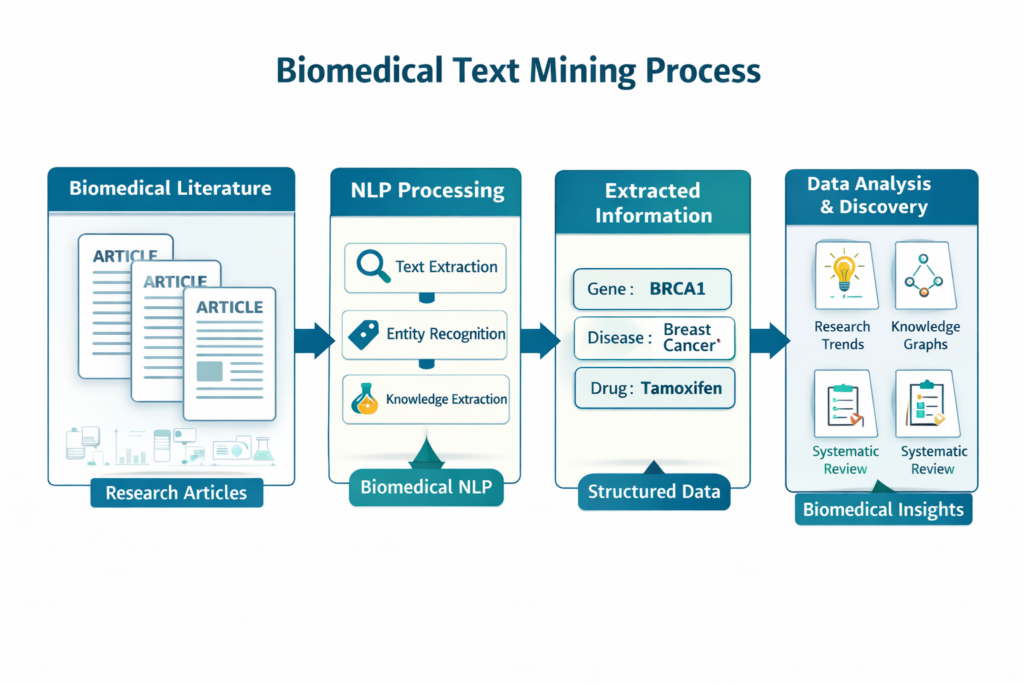
5. Biomedical Literature Mining
Thousands of research articles are published daily. NLP helps in:
- Identifying research trends
- Extracting gene-disease relationships
- Supporting systematic reviews
This enhances evidence-based medicine.
NLP Workflow in Biostatistics
Below is a typical NLP workflow used in biomedical research:
| Step | Description | Example in Biostatistics |
|---|---|---|
| Data Collection | Gather clinical text data | EHR notes |
| Text Cleaning | Remove punctuation, stopwords | Clean patient reports |
| Tokenization | Split text into words | “High blood pressure” → tokens |
| Named Entity Recognition | Identify medical entities | Diabetes, Hypertension |
| Feature Extraction | Convert text into numerical format | TF-IDF vectors |
| Statistical Analysis | Apply biostatistical models | Logistic regression |
| Interpretation | Clinical decision making | Risk prediction |
This workflow transforms qualitative text into quantitative statistical variables.
Common NLP Techniques Used in Biostatistics
1. Bag of Words (BoW)
Counts word frequency in documents.
2. TF-IDF (Term Frequency–Inverse Document Frequency)
Measures importance of words.
3. Named Entity Recognition (NER)
Identifies medical terms like diseases, drugs, genes.
4. Sentiment Analysis
Used for patient feedback and mental health analysis.
5. Topic Modeling (LDA)
Discovers hidden themes in research articles.
Popular NLP Tools and Software for Biostatistics
| Tool | Language | Application |
|---|---|---|
| NLTK | Python | Basic NLP processing |
| spaCy | Python | Medical entity extraction |
| Scikit-learn | Python | Text classification |
| R (tm package) | R | Text mining in biostatistics |
| BioBERT | Python | Biomedical language modeling |
Example: NLP with Biostatistical Analysis
Suppose we collect 500 clinical notes of diabetic patients.
Steps:
- Use NLP to extract terms like:
- “HbA1c”
- “Hypertension”
- “Insulin therapy”
- Convert presence/absence into binary variables.
- Apply logistic regression to predict complications.
This integrates NLP with traditional biostatistical modeling.
Advantages of NLP in Biostatistics
- Handles large-scale text data
- Improves clinical decision support
- Reduces manual data entry
- Enhances research efficiency
- Enables real-time public health monitoring
Challenges of NLP in Biostatistics
Despite its power, NLP faces limitations:
- Medical terminology complexity
- Data privacy concerns
- Ambiguity in clinical language
- Requirement of large training datasets
- Need for interdisciplinary expertise
Ethical handling of patient data is especially important in healthcare research.
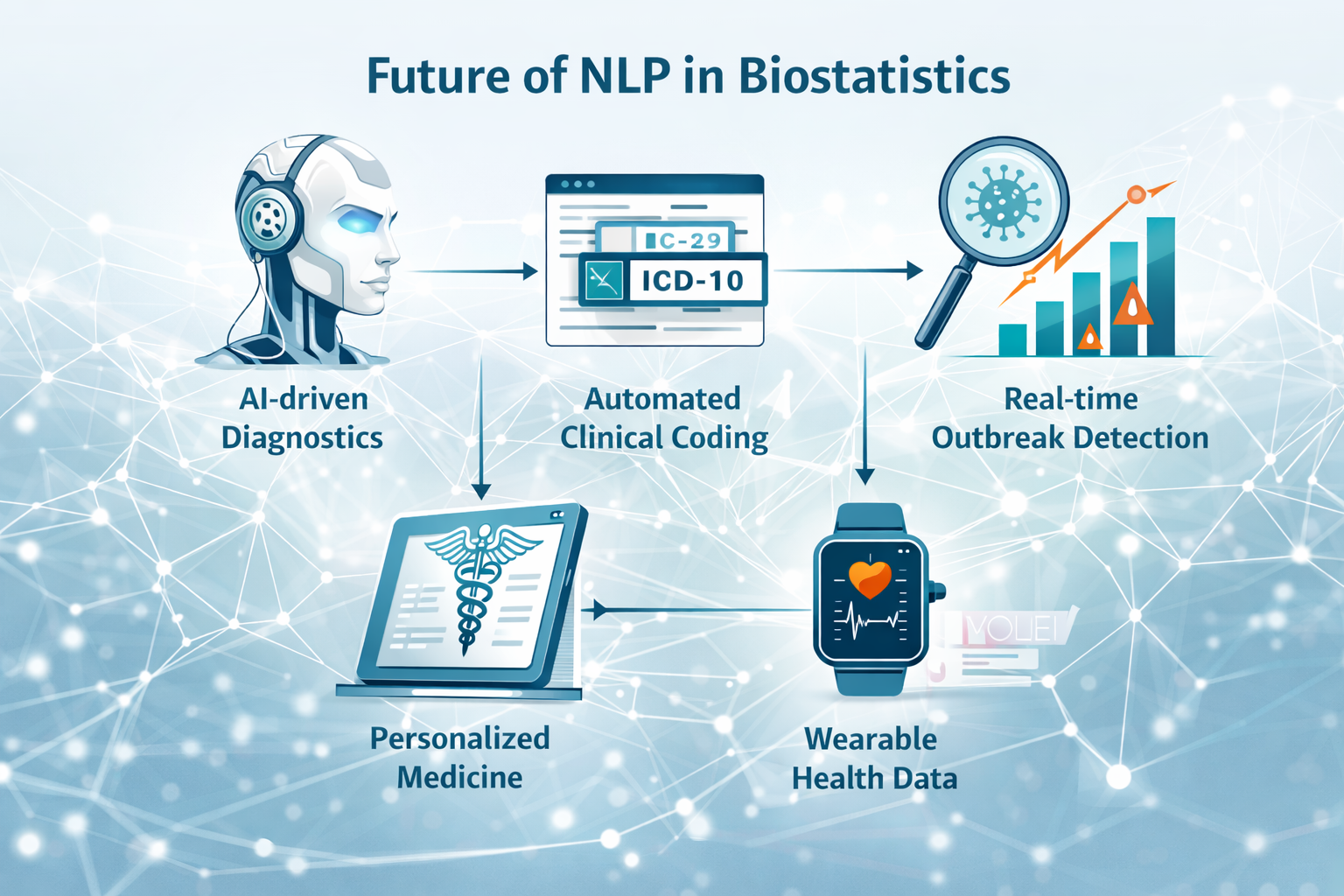
Future Scope of NLP in Biostatistics
The future of NLP in biostatistics is highly promising:
- AI-driven diagnostic support
- Automated clinical coding
- Personalized medicine
- Real-time outbreak detection
- Integration with wearable health data
With the advancement of deep learning models such as transformers, NLP accuracy in biomedical tasks continues to improve.
Biostatisticians of the future must acquire basic machine learning and NLP skills to stay competitive.
Integration of NLP with Machine Learning
NLP models often combine with:
- Logistic Regression
- Random Forest
- Support Vector Machines
- Deep Neural Networks
This creates predictive healthcare models capable of early disease detection.
For your students and YouTube audience, this topic can be an excellent advanced biostatistics series.
Practical Implementation in R (Basic Concept)
In R, you can:
- Import text dataset
- Use
tmpackage - Create corpus
- Clean text
- Generate Document-Term Matrix
- Perform clustering or regression
This bridges programming and biostatistics effectively.
Conclusion
Natural Language Processing has revolutionized how textual healthcare data is analyzed. By converting unstructured clinical text into structured statistical variables, NLP enhances the power of biostatistics in medical research, public health, and clinical decision-making.
The integration of NLP with statistical modeling enables:
- Accurate disease prediction
- Drug safety monitoring
- Efficient research analysis
- Evidence-based healthcare improvements
As healthcare data continues to grow exponentially, the collaboration between NLP and biostatistics will become even more essential.
For biostatistics students and researchers, learning NLP is no longer optional—it is a strategic advantage in modern biomedical research.