
Introduction
The rapid growth of biological, medical, and healthcare data has transformed the way researchers conduct scientific investigations. Modern research generates enormous amounts of information from clinical trials, electronic health records, genomic sequencing, medical imaging, wearable devices, and population-based studies. Traditional statistical approaches may not be sufficient to process and analyze such large and complex datasets efficiently.
Big Data in Biostatistics combines statistical science, computational techniques, and advanced data analytics to extract meaningful information from large biological and healthcare datasets. It helps researchers identify disease patterns, evaluate treatment effectiveness, understand genetic variations, and improve healthcare decision-making.
With the development of artificial intelligence (AI), machine learning, cloud computing, and high-performance computing, big data has become an important component of modern biostatistical research.
1. Definition of Big Data in Biostatistics
Big Data in Biostatistics refers to the collection, management, processing, and statistical analysis of extremely large, complex, and diverse datasets generated from biological, medical, clinical, and public health research.
It involves advanced computational and statistical methods to identify relationships, trends, associations, and predictive patterns that may not be easily detected using conventional analytical techniques.
Five Key Characteristics of Big Data
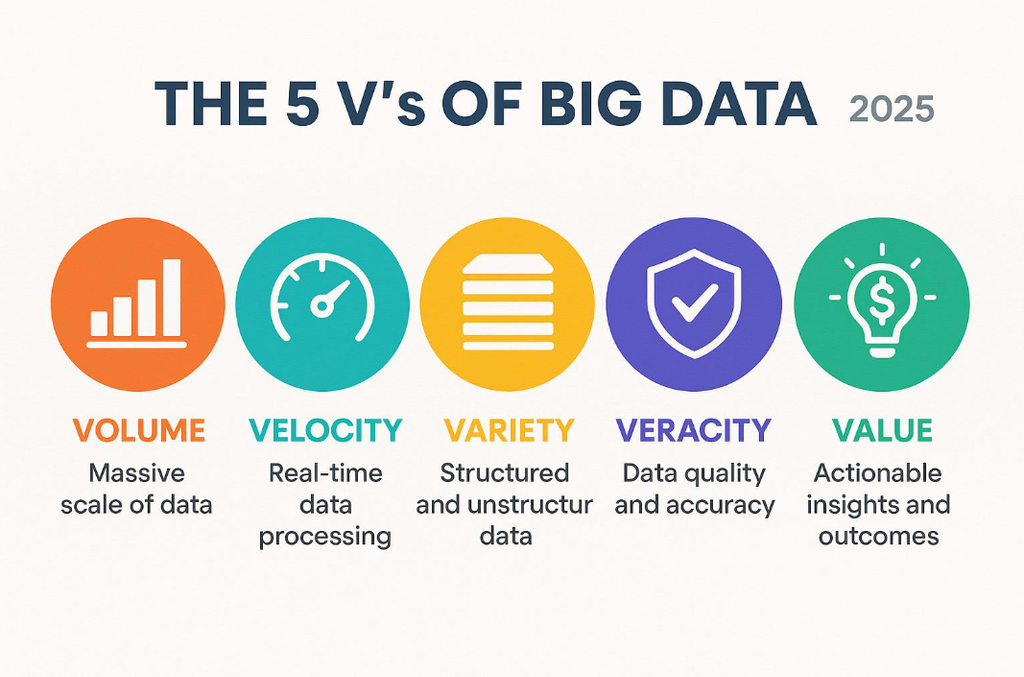
- Volume: Large quantities of biological and healthcare data.
- Velocity: Rapid generation and processing of data.
- Variety: Different data formats, including numerical, textual, genomic, and imaging data.
- Veracity: Accuracy, reliability, and quality of collected information.
- Value: Useful scientific discoveries and meaningful research outcomes.
2. Applications of Big Data in Biostatistics
Big data analytics has several applications in modern biological and medical research.
2.1 Clinical Research
Clinical researchers use large datasets to evaluate drug effectiveness, treatment outcomes, adverse events, and patient responses. Statistical modeling helps identify differences between treatment groups and supports evidence-based conclusions.
2.2 Genomics and Bioinformatics
Genomic research generates massive datasets through DNA sequencing and gene expression analysis. Big data methods help identify genetic variations, disease-associated genes, and molecular relationships.
2.3 Epidemiology and Public Health
Epidemiologists analyze population-level data to investigate disease prevalence, incidence, risk factors, and outbreak patterns. Predictive analytics can support disease surveillance and public health planning.
2.4 Personalized Medicine
Big data integrates clinical, genetic, and demographic information to support individualized treatment decisions. It helps researchers investigate why patients respond differently to the same treatment.
2.5 Medical Imaging
Large collections of MRI, CT, ultrasound, and digital pathology images can be analyzed using computational methods and machine learning to identify abnormalities and support diagnostic research.
3. Statistical Methods Used in Big Data Biostatistics
Several statistical and computational techniques are used to analyze large biological datasets.
| Statistical Method | Application in Biostatistics |
|---|---|
| Descriptive Statistics | Summarizing large datasets using mean, median, SD, and frequency |
| Regression Analysis | Identifying relationships between biological variables |
| ANOVA | Comparing mean responses among multiple experimental groups |
| Machine Learning | Classification and prediction of disease outcomes |
| Survival Analysis | Studying time-to-event outcomes in clinical research |
| Principal Component Analysis (PCA) | Reducing dimensionality in complex datasets |
| Cluster Analysis | Grouping patients or biological samples based on similarities |
| Deep Learning | Analyzing complex genomic and medical imaging data |
4. Big Data Analysis: Step-by-Step Process
Big data analysis in biostatistics follows a systematic workflow to ensure that the results are scientifically meaningful.
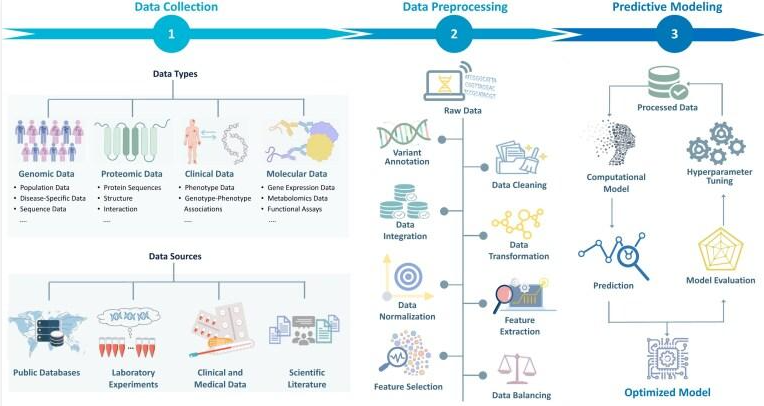
Step 1: Data Collection
Collect biological and medical data from clinical trials, laboratory experiments, electronic health records, genomic databases, and population surveys.
Step 2: Data Cleaning
Identify missing observations, duplicate records, incorrect values, and inconsistent data formats. Data quality is essential for reliable statistical analysis.
Step 3: Data Preprocessing
Organize variables, encode categorical data, standardize measurements when appropriate, and prepare the dataset for analysis.
Step 4: Statistical Analysis
Apply suitable statistical methods such as regression, ANOVA, correlation, survival analysis, or machine learning according to the research objectives.
Step 5: Data Visualization
Present the findings using graphs, charts, heatmaps, boxplots, and interactive dashboards to identify trends and relationships.
Step 6: Interpretation
Interpret statistical results, confidence intervals, effect sizes, and predictive performance in the context of biological or clinical research.
Step 7: Scientific Reporting
Prepare tables, figures, and research reports to communicate findings clearly and transparently.
5. Practical Example: Big Data in Diabetes Research
Consider a research study involving 100,000 individuals to investigate risk factors associated with Type 2 diabetes.
The dataset may contain:
- Age and gender
- Body Mass Index (BMI)
- Blood glucose levels
- Blood pressure
- Cholesterol levels
- Physical activity
- Family history
- Diabetes diagnosis
Researchers can apply logistic regression and machine learning techniques to identify important risk factors and estimate the probability of diabetes.
Illustrative Data Analysis Table
| Variable | Mean ± SD / Percentage |
|---|---|
| Age (years) | 48.5 ± 12.4 |
| BMI (kg/m²) | 27.8 ± 5.2 |
| Fasting Blood Glucose (mg/dL) | 112.6 ± 24.8 |
| Systolic Blood Pressure (mmHg) | 128.4 ± 16.2 |
| Diabetes Prevalence | 18.5% |
Note: These values are hypothetical and provided only to demonstrate the presentation of a big data research dataset.
Using these data, researchers can investigate associations between BMI, blood glucose, age, and diabetes status. A predictive model may help identify individuals who require further clinical assessment. Such predictions should be validated before clinical use.
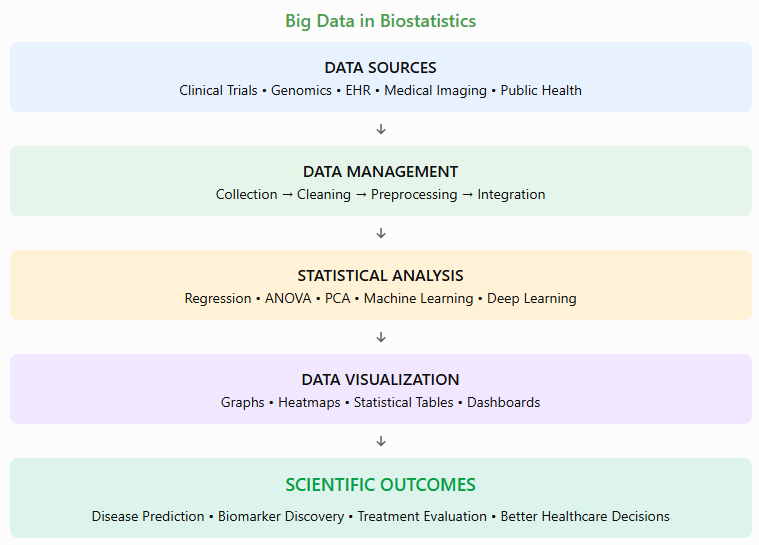
6. Figure: Big Data in Biostatistics Framework
The following conceptual figure illustrates the relationship between data sources, analytical methods, and research outcomes.
7. Future Trends of Big Data in Biostatistics
The future of biostatistics will increasingly depend on advanced computational technologies and integrated biological datasets.
Artificial Intelligence and Machine Learning
AI-driven statistical models will support disease prediction, biomarker identification, and automated analysis of complex medical datasets.
Precision Medicine
Combining genomic, clinical, and lifestyle information will improve understanding of individual variations in disease susceptibility and treatment response.
Real-Time Health Data Analytics
Wearable devices and digital health platforms will provide continuous physiological measurements, creating opportunities for longitudinal research and real-time monitoring.
Cloud Computing
Cloud-based platforms will support large-scale data storage, collaborative research, and computationally intensive statistical analysis.
Data Privacy and Ethical Research
Privacy-preserving methods, secure data sharing, and responsible AI will become increasingly important when analyzing sensitive patient information.
Integration of Multi-Omics Data
Combining genomics, transcriptomics, proteomics, and metabolomics will help researchers understand complex biological systems and disease mechanisms.
8. Challenges of Big Data in Biostatistics
Despite its advantages, big data analysis presents several challenges:
- Data privacy and confidentiality.
- Missing and inconsistent observations.
- High computational and storage requirements.
- Bias in datasets and predictive algorithms.
- Difficulty interpreting complex models.
- Need for statistical validation and reproducibility.
Researchers must select appropriate methods, evaluate model assumptions, and ensure that statistical findings are biologically meaningful.
Conclusion
Big Data in Biostatistics is transforming biological research, clinical investigations, epidemiology, and healthcare analytics. By integrating large datasets with statistical methods, machine learning, and advanced computational technologies, researchers can identify complex patterns, investigate disease mechanisms, and improve scientific decision-making.
The integration of artificial intelligence, precision medicine, cloud computing, and multi-omics analysis will create new opportunities for biostatistical research. However, data quality, privacy, model validation, and scientific interpretation remain essential for achieving reliable results.
Ultimately, big data is not simply about analyzing larger datasets; it is about converting complex biological information into meaningful scientific knowledge.