
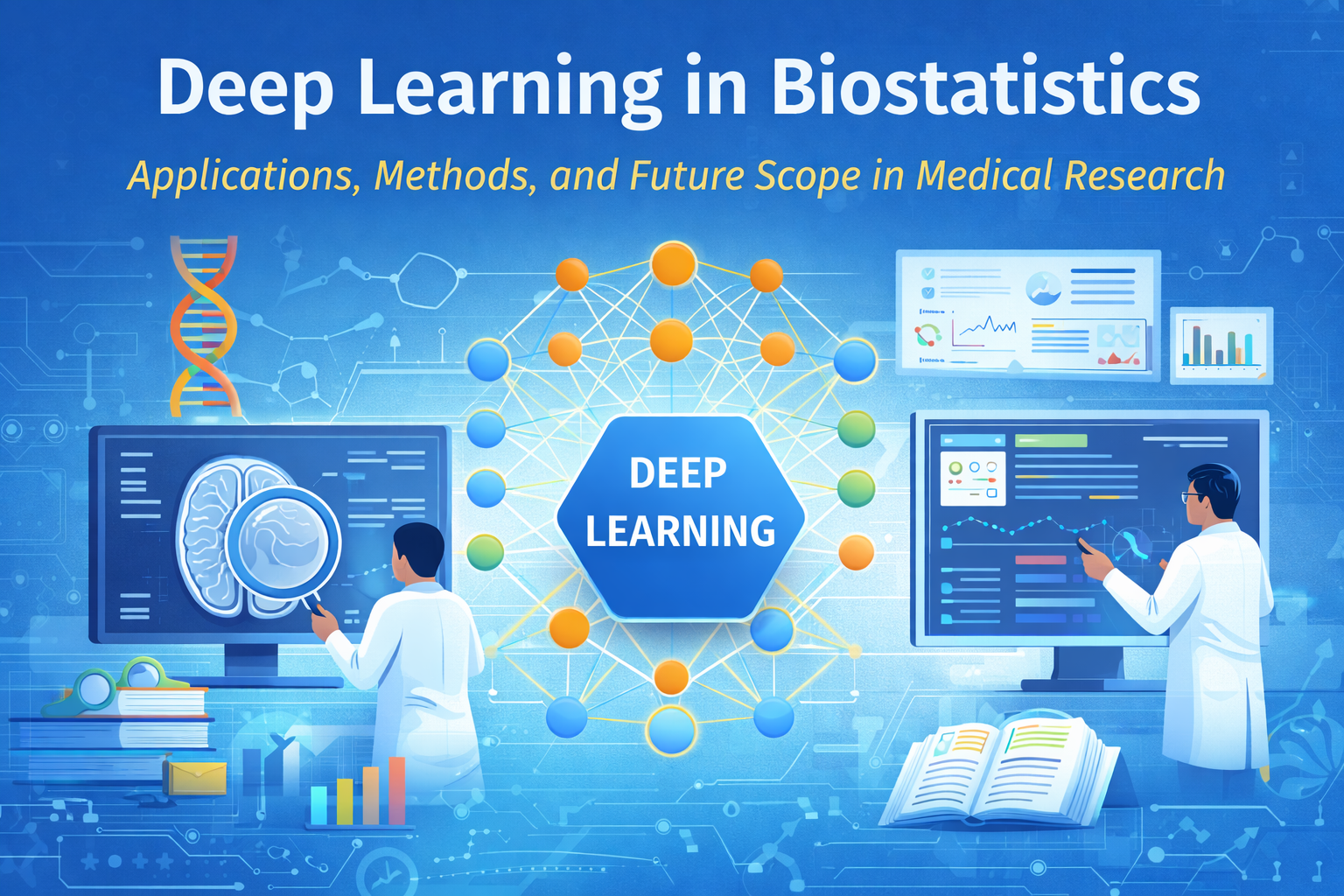
Introduction
Biostatistics has long been the backbone of medical research, epidemiology, and public health analysis. Traditional statistical methods such as regression models, survival analysis, and ANOVA have played a crucial role in analyzing biomedical data. However, the rapid growth of high-dimensional datasets—especially in genomics, medical imaging, wearable health devices, and electronic health records—has created the need for more powerful analytical techniques.
This is where Deep Learning (DL) comes into the picture.
Deep Learning, a subset of machine learning and artificial intelligence, uses artificial neural networks with multiple layers to model complex patterns in data. In recent years, Deep Learning has significantly enhanced the capabilities of biostatistical analysis by improving prediction accuracy, handling large-scale data, and uncovering hidden nonlinear relationships.
In this article, we will explore:
- What Deep Learning is
- Why it is important in biostatistics
- Core Deep Learning models used in medical research
- Applications in healthcare
- Advantages and limitations
- Future scope
What is Deep Learning?
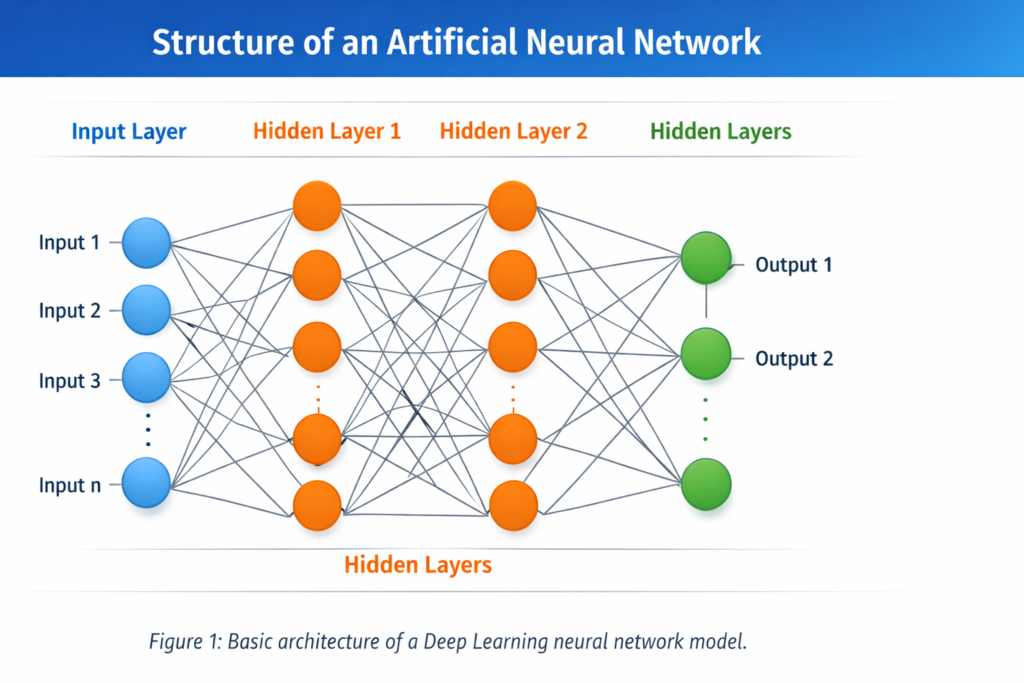
Deep Learning is a subset of Machine Learning based on artificial neural networks inspired by the human brain. These neural networks consist of:
- Input layer
- Hidden layers (multiple layers = “deep”)
- Output layer
Unlike traditional statistical models that rely on predefined assumptions, Deep Learning models automatically learn features from raw data.
Why Deep Learning is Important in Biostatistics
Traditional biostatistical methods work well when:
- Sample size is moderate
- Variables are limited
- Assumptions like normality hold
However, modern biomedical data often includes:
- Millions of genomic markers
- High-resolution medical images
- Continuous monitoring sensor data
- Large electronic health records
Deep Learning helps by:
- Handling high-dimensional data
- Capturing nonlinear relationships
- Improving predictive performance
- Automating feature extraction
For example, in cancer diagnosis using imaging data, Deep Learning can detect subtle patterns invisible to traditional regression models.
Core Deep Learning Models Used in Biostatistics
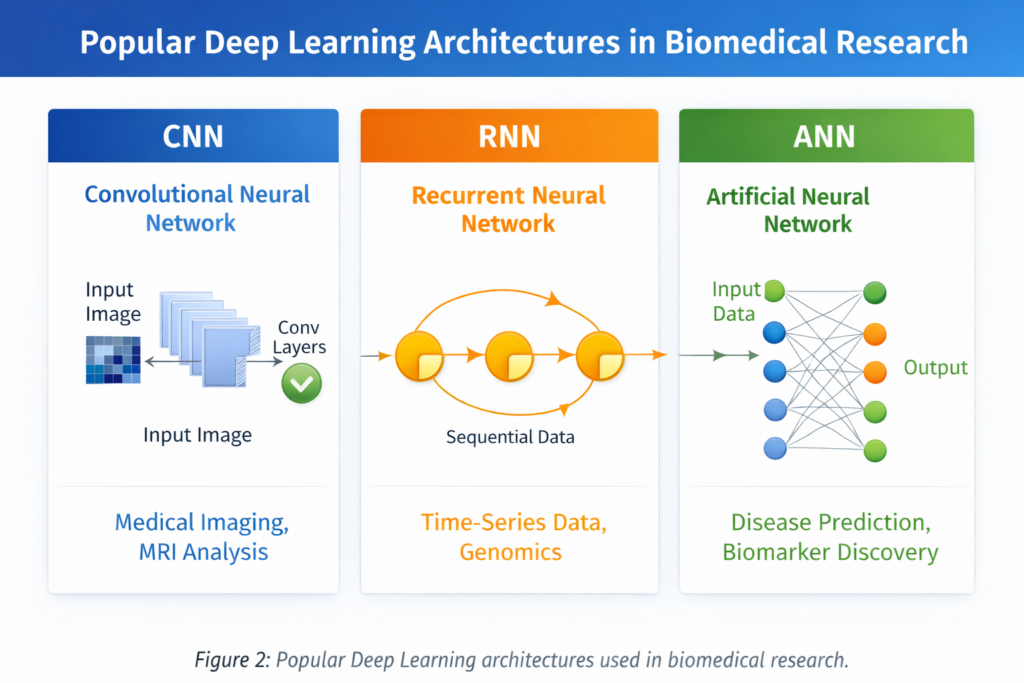
Below is a structured overview of commonly used Deep Learning architectures in medical and biostatistical research:
| Model | Full Form | Main Application in Biostatistics | Example Use Case |
|---|---|---|---|
| ANN | Artificial Neural Network | General prediction modeling | Disease risk prediction |
| CNN | Convolutional Neural Network | Image analysis | Tumor detection in MRI |
| RNN | Recurrent Neural Network | Sequential data analysis | ECG signal analysis |
| LSTM | Long Short-Term Memory | Time-series data | Patient vital sign monitoring |
| Autoencoder | Unsupervised neural model | Dimensionality reduction | Genomic feature extraction |
| GAN | Generative Adversarial Network | Data simulation | Synthetic medical data generation |
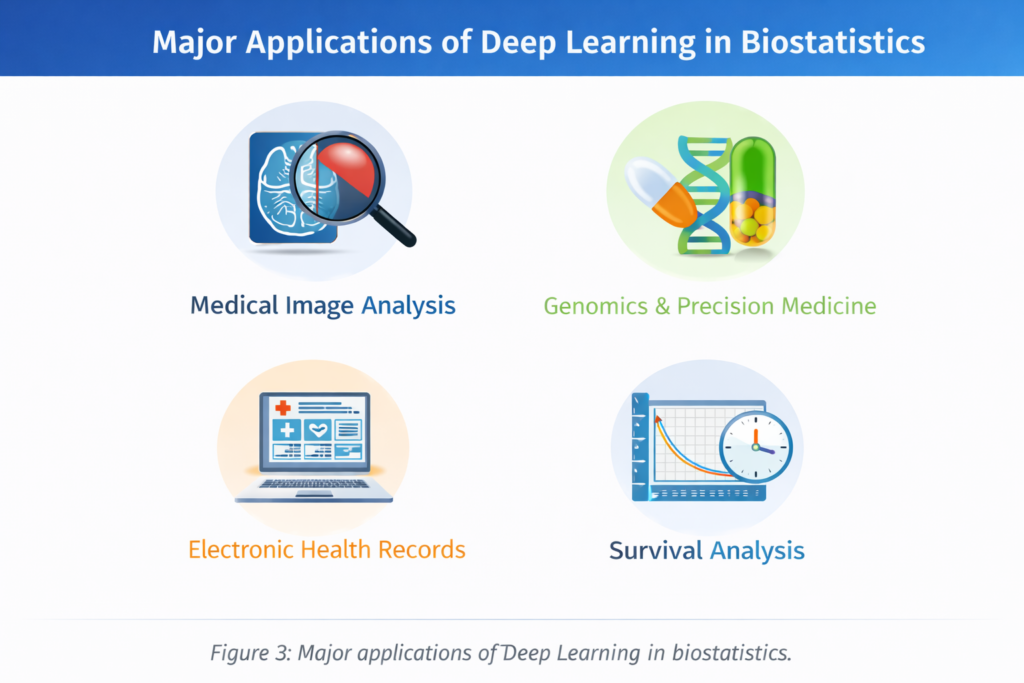
Applications of Deep Learning in Biostatistics
1. Medical Image Analysis
One of the most impactful areas is medical imaging. Deep Learning models, especially CNNs, are widely used for:
- Cancer detection
- Tumor segmentation
- Radiology image classification
- Diabetic retinopathy detection
These models often outperform traditional logistic regression and support vector machines.
2. Genomics and Precision Medicine
High-throughput genomic data involves thousands of genes. Deep Learning helps in:
- Gene expression classification
- Mutation detection
- Biomarker discovery
- Personalized treatment prediction
Autoencoders and deep neural networks reduce dimensionality while preserving critical information.
3. Survival Analysis Enhancement
Traditional survival analysis methods like Cox proportional hazards models assume linearity and proportional hazards. Deep Learning-based survival models can:
- Model nonlinear hazard relationships
- Incorporate imaging and genomic data
- Improve mortality risk prediction
4. Electronic Health Record (EHR) Analysis
Hospitals generate massive EHR data daily. Deep Learning models can:
- Predict hospital readmission
- Detect adverse drug reactions
- Forecast disease progression
- Assist in clinical decision-making
5. Epidemiological Modeling
Deep Learning is increasingly used in:
- Infectious disease outbreak prediction
- COVID-19 trend modeling
- Population risk assessment
It can integrate demographic, environmental, and mobility data effectively.
Comparison: Traditional Biostatistics vs Deep Learning
| Feature | Traditional Biostatistics | Deep Learning |
|---|---|---|
| Assumptions | Requires statistical assumptions | Fewer strict assumptions |
| Data Type | Structured data | Structured + unstructured |
| Interpretability | High | Often low (black box) |
| Sample Size | Moderate | Large datasets required |
| Feature Engineering | Manual | Automatic |
| Prediction Accuracy | Good | Often superior |
Deep Learning does not replace traditional biostatistics. Instead, it complements it.
Software and Tools for Deep Learning in Biostatistics
Biostatisticians can implement Deep Learning using:
- R (keras, torch packages)
- Python (TensorFlow, PyTorch)
- MATLAB
- MedCalc (for preprocessing and statistical comparison)
For beginners in biostatistics, combining R programming with deep learning libraries is a powerful starting point.
Since you are building biostatistics content for NextGenbiost, you can create tutorials comparing:
- Logistic regression vs neural networks
- Cox model vs deep survival model
- PCA vs Autoencoder
This will attract advanced learners.
Advantages of Deep Learning in Biostatistics
- High predictive power
- Handles complex nonlinear relationships
- Works with big data
- Learns features automatically
- Integrates multiple data sources
Limitations and Challenges
Despite its strengths, Deep Learning has some challenges:
- Requires large datasets
- Computationally expensive
- Less interpretable (black-box nature)
- Risk of overfitting
- Ethical and privacy concerns
Interpretability is particularly important in healthcare because clinicians need transparent decision models.
To address this, researchers use:
- SHAP values
- Explainable AI (XAI)
- Feature importance analysis
Future Scope of Deep Learning in Biostatistics
The future of Deep Learning in biostatistics is promising. Emerging trends include:
- Integration with wearable health devices
- Real-time patient monitoring
- AI-assisted drug discovery
- Multi-omics data integration
- Federated learning for privacy-preserving research
As healthcare becomes increasingly data-driven, biostatisticians must adapt by learning AI-based analytical tools.
For students and researchers, understanding Deep Learning is becoming as important as learning regression analysis or survival models.
Practical Research Example
Consider a cancer survival study:
Traditional approach:
- Cox proportional hazards model
- Limited predictors
Deep Learning approach:
- Combine imaging data + genomic markers + clinical variables
- Use deep survival neural network
- Achieve improved prediction accuracy
This integration demonstrates how Deep Learning expands biostatistical methodology.
Ethical Considerations
When using Deep Learning in medical research:
- Protect patient privacy
- Ensure algorithm fairness
- Validate models externally
- Avoid bias in training datasets
Responsible AI is essential in healthcare.
Conclusion
Deep Learning in Biostatistics represents a transformative advancement in medical data analysis. While traditional statistical methods remain essential for hypothesis testing and interpretability, Deep Learning provides powerful tools for prediction, high-dimensional data analysis, and automated feature learning.
The integration of artificial intelligence with biostatistics is not about replacement—it is about enhancement. By combining statistical reasoning with deep learning algorithms, researchers can develop more accurate, scalable, and impactful healthcare solutions.
For students, researchers, and healthcare professionals, learning Deep Learning techniques is no longer optional—it is becoming a necessity in modern biomedical research.
As biomedical datasets continue to grow in size and complexity, Deep Learning will play an increasingly central role in shaping the future of biostatistics.