
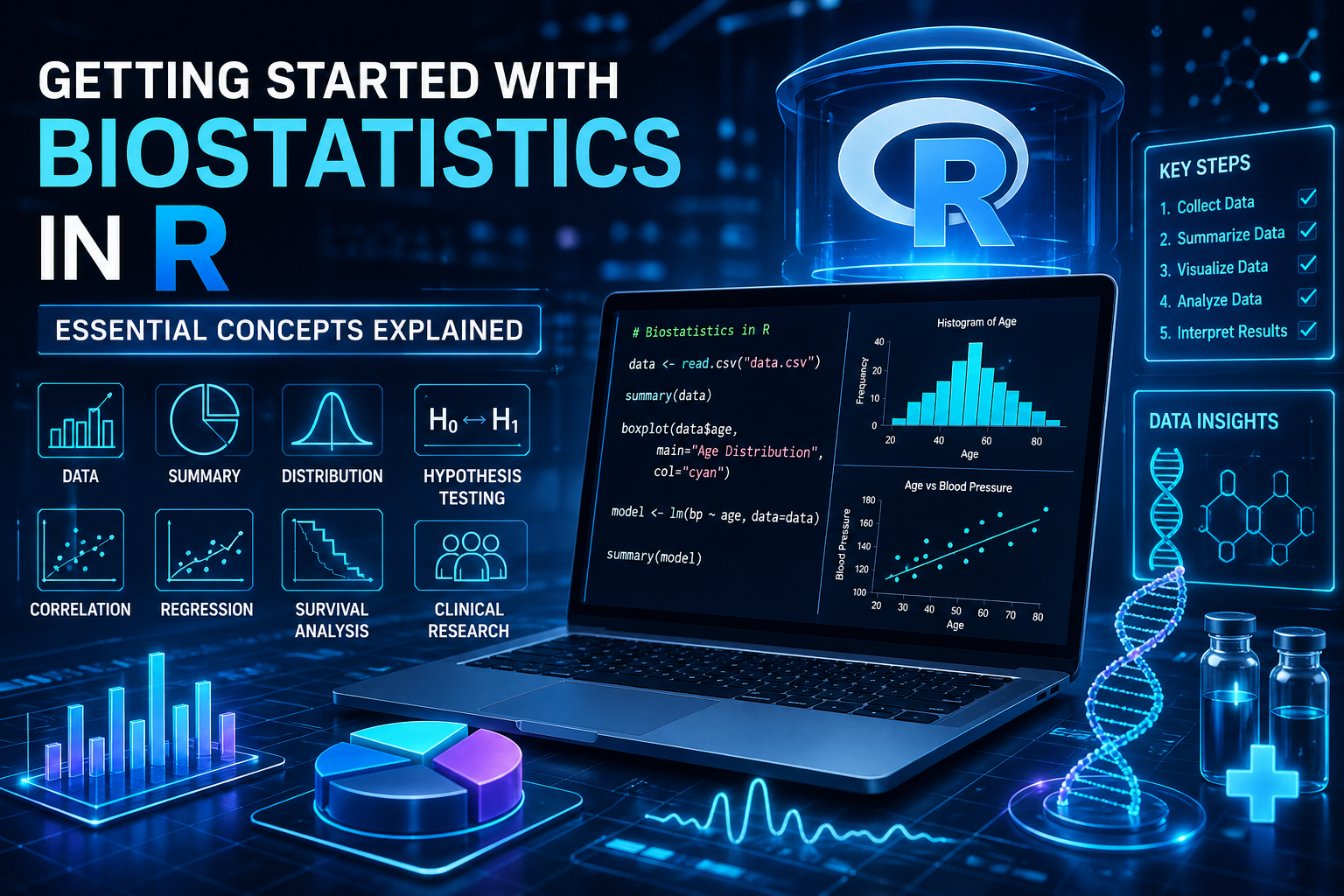
Introduction
Biostatistics plays a crucial role in modern healthcare, medical research, and life sciences. From analyzing clinical trial data to understanding disease patterns, statistical methods help researchers make evidence-based decisions. With the rise of data-driven research, tools like R have become essential for biostatistical analysis.
R is a powerful, open-source statistical programming language widely used by biostatisticians due to its flexibility, extensive packages, and strong visualization capabilities. Whether you are a beginner or a researcher entering the field, understanding how to use R for biostatistics can significantly enhance your analytical skills.
In this guide, we will explore the fundamental concepts of biostatistics using R, step-by-step explanations, practical examples, and a sample dataset to help you get started confidently.
What is Biostatistics?
Biostatistics is the application of statistical methods to biological, medical, and health-related data. It involves collecting, analyzing, interpreting, and presenting data to draw meaningful conclusions in healthcare and research.
Key Objectives of Biostatistics
- Designing experiments and clinical trials
- Summarizing biological data
- Testing hypotheses
- Making predictions in health sciences
- Supporting decision-making in medicine
What is R in Biostatistics?
R is a statistical programming language used for:
- Data manipulation
- Statistical modeling
- Data visualization
- Hypothesis testing
It is widely used in biostatistics because of packages like:
- ggplot2 (visualization)
- dplyr (data manipulation)
- survival (survival analysis)
- epiR (epidemiological analysis)
Essential Concepts in Biostatistics Using R
1. Types of Data
Understanding data types is the foundation of biostatistics.
a. Qualitative Data
- Categorical (e.g., gender, blood group)
b. Quantitative Data
- Numerical (e.g., age, weight, blood pressure)
2. Measures of Central Tendency
These summarize the data into a single value.
- Mean: Average value
- Median: Middle value
- Mode: Most frequent value
R Example
data <- c(10, 20, 30, 40, 50)

mean(data)
median(data)
3. Measures of Dispersion
These describe variability in data.
- Range
- Variance
- Standard Deviation
R Example
var(data)
sd(data)
4. Data Visualization
Visualization helps interpret data easily.
Common plots:
- Bar chart
- Histogram
- Boxplot
R Example
hist(data, col="skyblue", main="Histogram of Data")
5. Probability in Biostatistics
Probability measures the likelihood of an event.
- Value ranges from 0 to 1
- Used in risk analysis and predictions
R Example
dbinom(2, size=5, prob=0.5)
6. Hypothesis Testing
Used to test assumptions about data.
Steps:
- Define null hypothesis (H₀)
- Define alternative hypothesis (H₁)
- Choose significance level (α)
- Perform test
- Interpret result
R Example (t-test)
t.test(data)
7. Correlation and Regression
Correlation
Measures relationship between variables.
x <- c(1,2,3,4,5)
y <- c(2,4,6,8,10)

cor(x,y)
Regression
Predicts outcomes.
model <- lm(y ~ x)
summary(model)
Step-by-Step Example in Biostatistics Using R
Let’s analyze a simple dataset of patients.
Sample Dataset
| Patient ID | Age | Weight | Blood Pressure |
|---|---|---|---|
| 1 | 25 | 60 | 120 |
| 2 | 30 | 70 | 130 |
| 3 | 35 | 80 | 135 |
| 4 | 40 | 85 | 140 |
| 5 | 45 | 90 | 145 |
Step 1: Create Dataset in R
data <- data.frame(
  Age = c(25,30,35,40,45),
  Weight = c(60,70,80,85,90),
  BP = c(120,130,135,140,145)
)
Step 2: Summary Statistics
summary(data)
Step 3: Visualization
plot(data$Age, data$BP, main="Age vs BP", col="blue")
Step 4: Correlation
cor(data$Age, data$BP)
Step 5: Regression Analysis
model <- lm(BP ~ Age, data=data)
summary(model)
Interpretation of Results
- The mean values give an overall understanding of patient characteristics
- The correlation shows how strongly age and blood pressure are related
- The regression model predicts blood pressure based on age
- Visualization helps identify trends and patterns
Advantages of Using R in Biostatistics
- Free and open-source
- Large community support
- Extensive packages for medical research
- Advanced visualization tools
- Reproducible research
Conclusion
Getting started with biostatistics in R may seem challenging at first, but with a clear understanding of basic concepts and consistent practice, it becomes a powerful tool for data analysis in healthcare and research.
This guide covered essential topics such as data types, descriptive statistics, visualization, probability, hypothesis testing, and regression analysis. By applying these concepts using R, you can analyze real-world biological data effectively and make informed decisions.
Whether you are a student, researcher, or healthcare professional, mastering biostatistics with R opens the door to advanced analytics and evidence-based research.