
Introduction
In today’s data-driven world, statistical analysis plays a crucial role in research, business intelligence, healthcare, ecology, bioinformatics, and social sciences. With the exponential growth of data, researchers and analysts increasingly rely on open-source statistical programming languages to analyze, visualize, and interpret complex datasets.
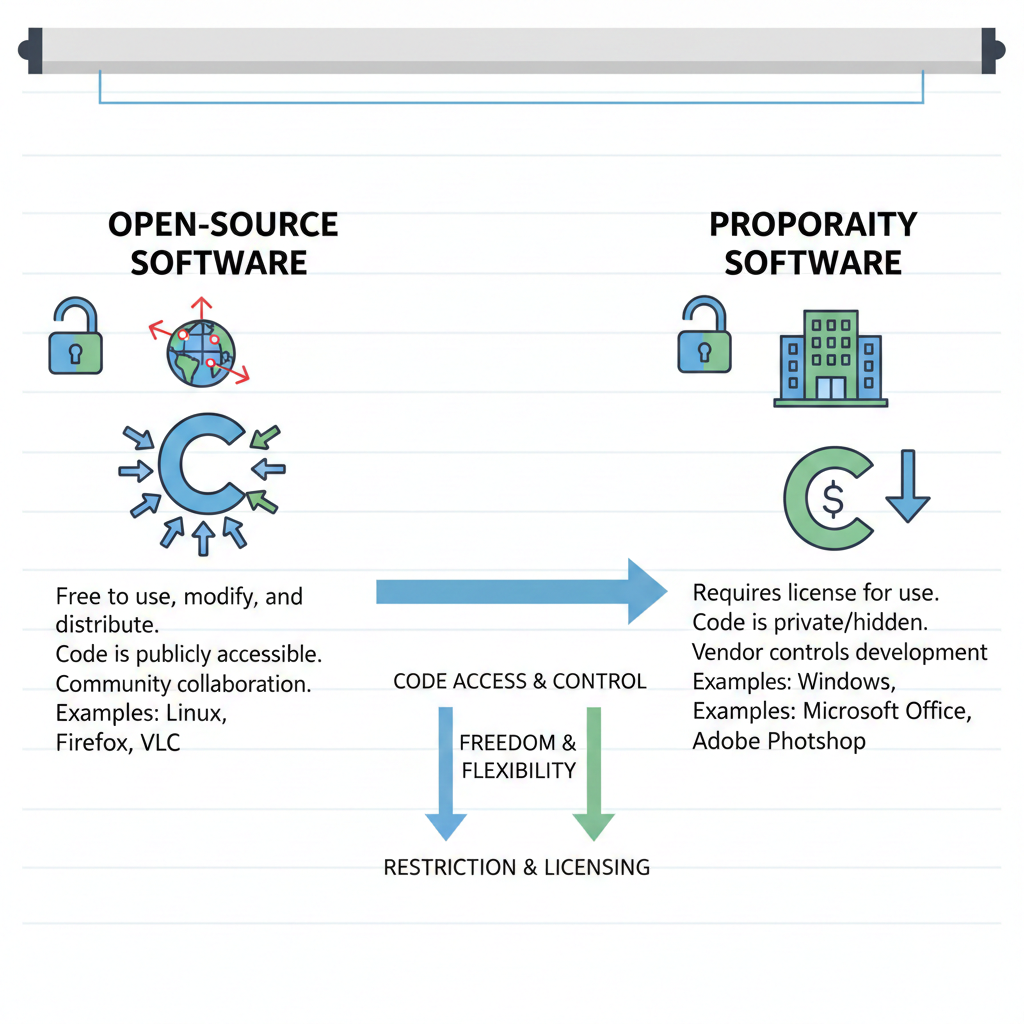
An open-source statistical programming language is a programming language whose source code is freely available to everyone. Users can study, modify, and distribute the software without licensing fees. This openness promotes transparency, reproducibility, innovation, and collaboration—key principles in modern scientific research.
This article provides a comprehensive overview of open-source statistical programming languages, their features, advantages, popular examples, real-world applications, and why they are essential for students, researchers, and professionals.
What Is an Open-Source Statistical Programming Language?
An open-source statistical programming language is a software tool designed for:
- Statistical computation
- Data analysis
- Data visualization
- Modeling and simulation
The defining feature is that the source code is publicly accessible, allowing users to:
- Verify algorithms
- Customize methods
- Extend functionality through packages
- Ensure reproducibility of results
Unlike proprietary software (e.g., SPSS, SAS, Stata), open-source tools are free, community-driven, and constantly evolving.
Why Open-Source Statistical Languages Are Important
Open-source statistical languages have become the backbone of modern data science and research due to the following reasons:
1. Cost-Effective
They are completely free, making them ideal for:
- Students
- Researchers in developing countries
- Small institutions and startups
2. Transparency and Reproducibility
Researchers can inspect the underlying algorithms, which:
- Improves scientific integrity
- Supports reproducible research
3. Community Support
Large global communities contribute:
- New packages
- Bug fixes
- Tutorials and documentation
4. Flexibility and Customization
Users can:
- Write custom functions
- Modify existing methods
- Automate workflows
Popular Open-Source Statistical Programming Languages
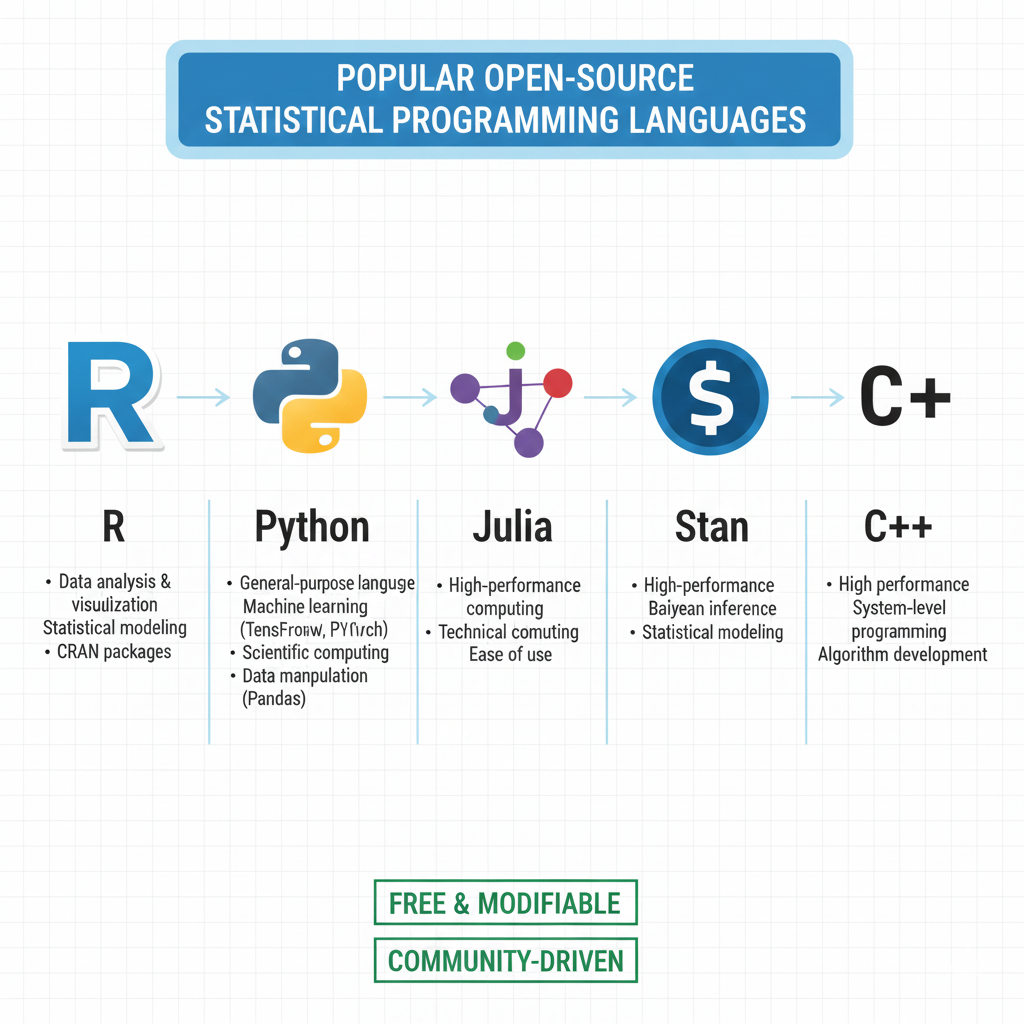
Below are the most widely used open-source statistical programming languages in research and industry.
Comparison of Popular Open-Source Statistical Languages
| Language | Primary Use | Strengths | Learning Curve |
|---|---|---|---|
| R | Statistics & Data Analysis | Advanced statistical models, visualization | Medium |
| Python | Data Science & AI | Simplicity, machine learning | Easy |
| Julia | High-Performance Computing | Speed, numerical analysis | Medium |
| GNU Octave | Numerical Computing | MATLAB-like syntax | Medium |
| PSPP | Statistical Analysis | SPSS alternative | Easy |
R: The Most Powerful Statistical Language
R is one of the most popular open-source statistical programming languages, especially in biostatistics, ecology, epidemiology, and social sciences.
Key Features of R
- Thousands of statistical packages (CRAN)
- Advanced data visualization (ggplot2)
- Strong support for regression, ANOVA, time series, and multivariate analysis
- Ideal for academic research
Common Applications
- Clinical trials
- Environmental data analysis
- Bioinformatics
- Econometrics
R is particularly valuable for researchers who require complex statistical modeling and high-quality visualizations.
Python for Statistical Analysis
Python is a general-purpose programming language that has become extremely popular in data science and machine learning.
Statistical Libraries in Python
- NumPy – numerical computing
- Pandas – data manipulation
- SciPy – statistical functions
- Statsmodels – classical statistics
- Matplotlib & Seaborn – visualization
Why Python Is Popular
- Easy to learn syntax
- Integration with AI and machine learning
- Suitable for automation and big data
Python is ideal for beginners who want to combine statistics, data analysis, and programming in one environment.
Julia: High-Performance Statistical Computing
Julia is a newer open-source language designed for high-speed numerical and statistical computing.
Advantages of Julia
- Faster than R and Python
- Easy mathematical syntax
- Suitable for simulations and large datasets
Julia is gaining popularity in computational biology, physics, and engineering, where performance matters.
GNU Octave and PSPP
GNU Octave
- MATLAB-compatible open-source alternative
- Used for numerical analysis and matrix computations
- Popular in engineering and applied sciences
PSPP
- Open-source alternative to SPSS
- GUI-based and command-line options
- Ideal for basic statistical analysis in social sciences
Applications of Open-Source Statistical Programming Languages
Open-source statistical languages are widely used across disciplines:
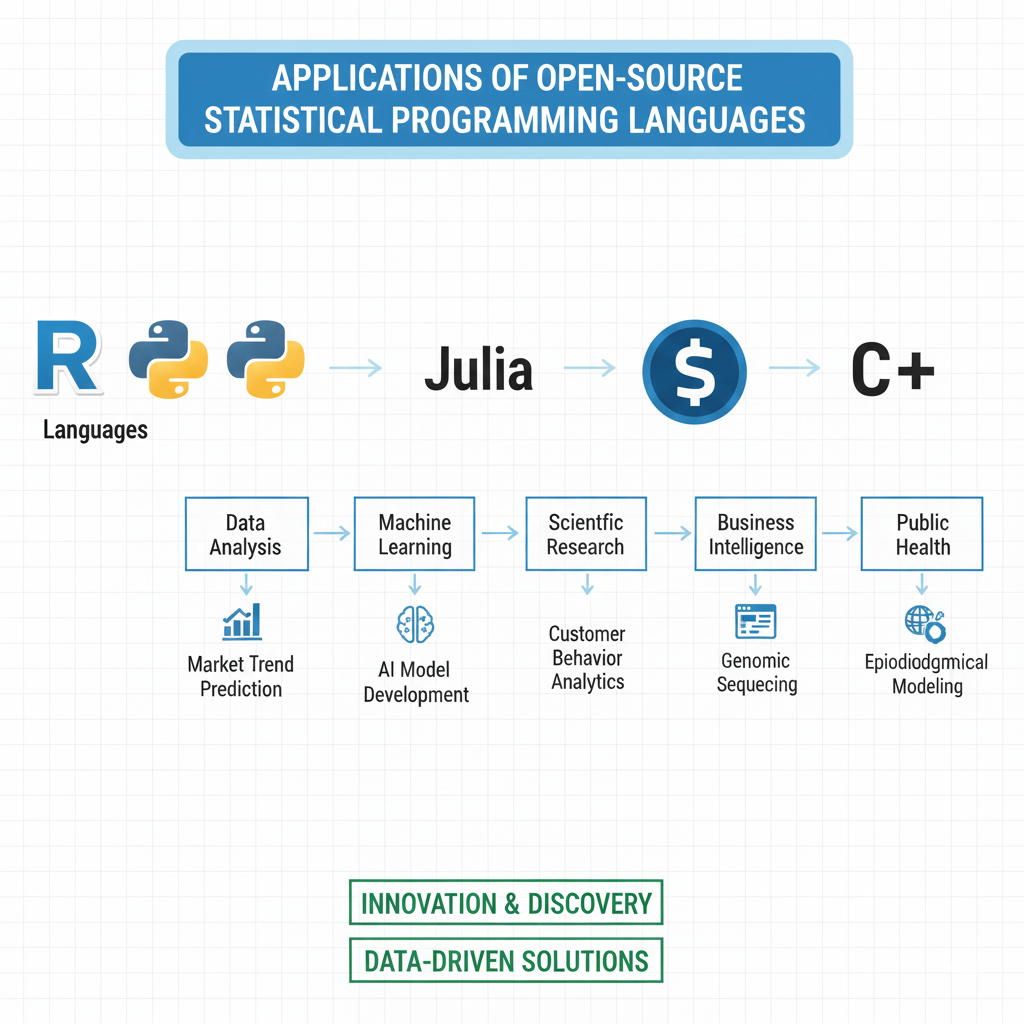
- Biostatistics: clinical trials, survival analysis
- Ecology: species distribution modeling
- Economics: forecasting, econometrics
- Public Health: epidemiological modeling
- Education: teaching statistics and programming
- Business Analytics: market analysis and prediction
Advantages Over Proprietary Statistical Software
| Feature | Open-Source | Proprietary |
|---|---|---|
| Cost | Free | Expensive licenses |
| Transparency | Full | Limited |
| Customization | High | Restricted |
| Community Support | Global | Vendor-based |
| Reproducibility | Excellent | Moderate |
Challenges of Open-Source Statistical Languages
Despite many advantages, there are some challenges:
- Steeper learning curve for non-programmers
- Command-line based interfaces
- Requires basic programming knowledge
However, these challenges are outweighed by long-term benefits and career opportunities.
Future of Open-Source Statistical Programming
The future is strongly aligned with open-source tools due to:
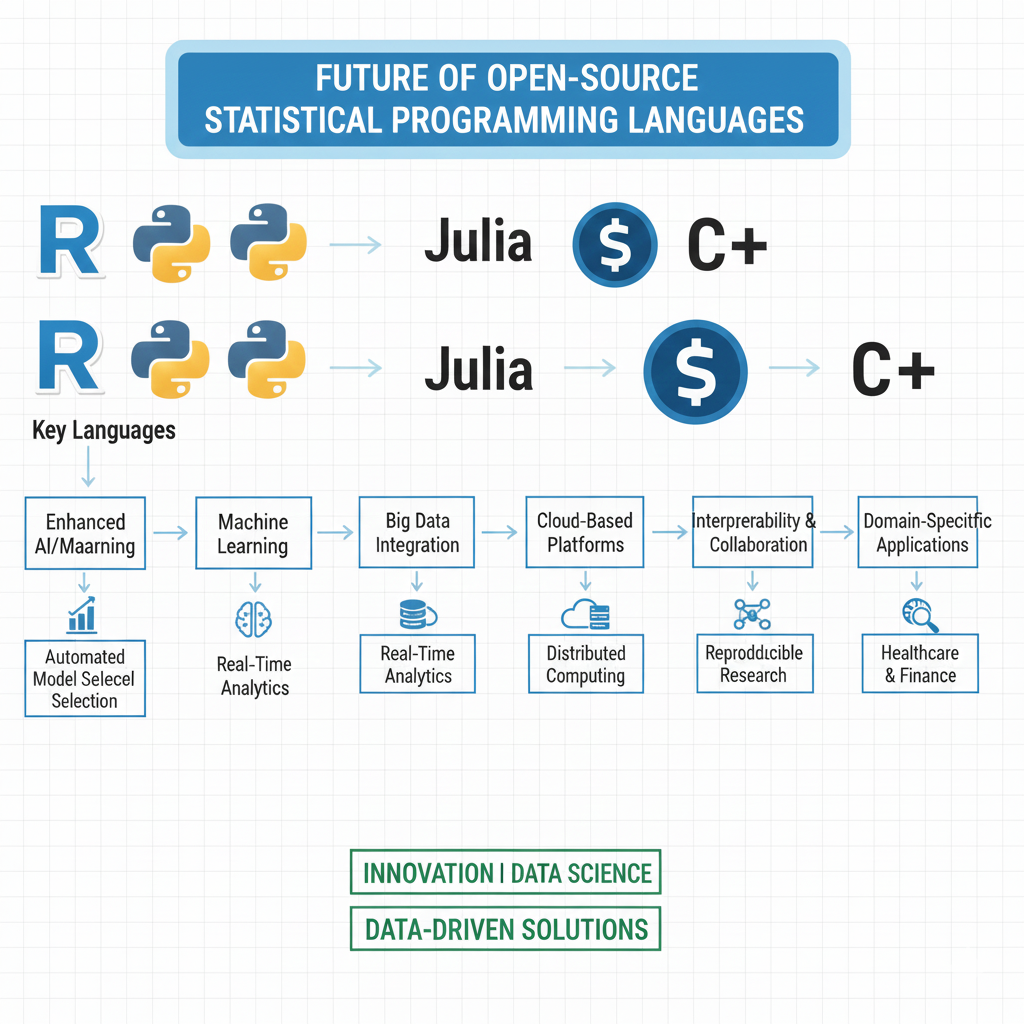
- Growth of data science and AI
- Demand for reproducible research
- Open science initiatives
- Integration with cloud computing
Languages like R and Python will continue to dominate academic and professional environments.
Conclusion
An open-source statistical programming language is no longer optional—it is essential for modern data analysis and research. These tools empower students, researchers, and professionals by offering free access, transparency, flexibility, and community support.
Whether you choose R for advanced statistics, Python for data science, or Julia for high-performance computing, open-source statistical languages provide powerful solutions without financial barriers. Embracing these tools enhances not only analytical skills but also career prospects in an increasingly data-driven world.